Australian Naval Aviation - Part 1
- Author
- Issacs, Group Captain Keith
- Categories
- Naval Aviation, Naval Historical Review
- Tags
- HMAS Australia I, HMAS Brisbane I, HMAS Encounter, HMAS Huon I, HMAS Melbourne I, HMAS Parramatta I, HMAS Pioneer, HMAS Swan I, HMAS Sydney I, HMAS Una, HMAS Yarra I
By Group Captain Keith Isaacs, AFC.
Group Captain Keith Isaacs is well qualified to write about military aircraft for he has flown with three air forces - the Royal Australian Air Force, Royal Air Force and United States Air Force. He was born at Drummoyne, New South Wales, on May 30 1921 and educated at the local St. Mark’s School, and St. Joseph’s High School, Rozelle.
He entered the Citizen Military Forces in 1941, transferred to the Australian Imperial Force in 1942 and in December that year joined the Royal Australian Air Force. He qualified as a pilot and spent most of the next 17 years flying four-engined aircraft - Consolidated Liberators, Avro Lincolns and Lockheed Hercules of the RAAF, Handley Page Hastings on exchange duty with No. 24 (Commonwealth) Squadron, RAF and Lockheed C130As on attachment to the 61st Troop Carrier Squadron, USAF. He also flew VIP versions of the Liberator, Hastings and Douglas Dakota. During the latter years of this period he was Commanding Officer of two RAAF transport squadrons. He climaxed a career of over 5,000 hours in the air by flying at Mach 2 in a Dassault Mirage 111-D while he was Commanding Off8icer, Base Squadron, RAAF Williamtown. He was awarded an Air Force Cross for his flying duties.
Although he has held staff appointments in recent years he still managed to publicise the RAAF in his spare time. Some of these latter activities included restoration of historic RAAF aircraft for display, design of the RAAF Williamtown badge, introduction of the service paper Mirage, and presentation of historical articles in Aircraft magazine and RAAF News, including the authoritative series Aircraft of the RAAF. In 1971 he was elected a Companion of the Royal Aeronautical Society. He is at present a member of the Directorate of RAAF Jubilee Year, and was part-author of the best-selling The Golden Years: Royal Australian Air Force 1921-1971.
THE HISTORY OF WORLD naval aviation began, tentatively, in the lighter-than-air era. As far back as November 1861, during the American Civil War, the Union Army - employing maritime techniques - released the Washington balloon from a remodelled coal barge, the G.W. Parke Curtis, to observe the enemy at Budd’s Ferry. In 1877 Commodore Cheyne of the British Navy proposed using three balloons in an expedition to the North Pole, and other international developments included the establishment of a French Naval Balloon Corps, the attempts by the Russians to improve naval signalling by using balloons, and the Swedish Navy Coast Defence Balloon Ship of 1903.
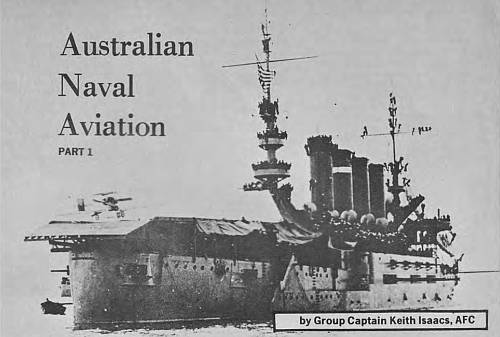
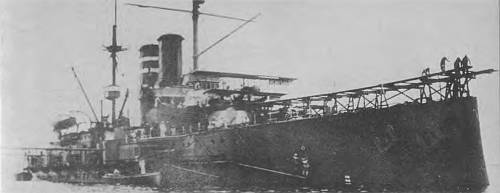
That year American naval authorities showed interest in Dr. Samuel Langley’s ‘Aerodrome’ tandem-wing aircraft, which made two unsuccessful attempts to get airborne from a launching track on a houseboat. It was not until July 1 1911, however, that the United States Navy purchased its first aircraft, the Curtiss A-1 Triad amphibian, so named because of its ability to operate from land, sea and air. This purchase came after two historic ‘firsts’ had been carried out by Eugene Ely, a Curtiss demonstration pilot. Ely flew a Curtiss pusher land-plane on November 14 1910 from USS Birmingham, which was in Hampton Roads, Virginia, and on January 18 1911 landed and took off from USS Pennsylvania, anchored in San Francisco Bay. In each case special platforms had been erected on the cruisers. A month later, on February 17, Curtiss himself paid a flying visit to the Pennsylvania in San Diego Bay, where his seaplane was hoisted aboard and later lowered over the side for take off. These trials convinced the United States Navy that aircraft would be of use to warships and, in fact, could well become ‘the eyes of the fleet’. In November 1912 the Curtiss A-3 seaplane made the first successful launch from a catapult, and next month the Curtiss C-1 became the first flying boat to be catapult-launched; both experiments took place at the Washington Navy yard. Three years later, on November 5 1915, the Curtiss AB-2 flying boat made the first catapult launching from a battleship, the USS North Carolina.
Meanwhile the British Navy had also concentrated on heavier-than-air craft after an unhappy experience with No 1 Rigid Naval Airship, the Mayfly, which broke up on the water in a wind squall on September 24 1911. Two months later Commander O. Schwann, who was attached to the Naval Airship Tender Hermione but was acting in a private capacity, carried out the first seaplane takeoff from British waters on November 18, when he became airborne in an Avro Type D fitted with air-bag floats. The first seaplane flight in the world had already been made by H. Fabre in France on March 28 1910, and Curtiss made the first hydroplane flight in America on January 26 1911. On January 10 1912 one of the Royal Navy’s first pilots, Sub-Lieutenant C.R. Samson, flew a Short S.38 (also referred to as a modified Short S.27) from a specially built track of 100 feet on the foredeck of HMS Africa while the ship was at anchor. This same aircraft had been tested previously in December 1911 by the Australian, Sub-Lieutenant A.M. Longmore, when three airbags were attached to the undercarriage struts and tail unit to enable him to alight on the water. Still using the Short S.38, Samson repeated his take-off feat on May 9 1912, only this time the warship HMS Hibernia, which had been fitted with Africa’s aircraft ramp, was under way at Weymouth steaming at 10-15 knots.
On May 13 1912 the Royal Flying Corps came into being with a Military Wing and a Naval Wing. In 1913 the British light cruiser, HMS Hermes, was fitted out to accommodate two seaplanes and, later in the year, another ship was taken over by the Admiralty while still lying in frame on her building slip. She was completed in 1914 as the first seaplane carrier to be built as such from the stocks. Her name was HMS Ark Royal and she was the forerunner of two similarly named later aircraft carriers, the first of which achieved fame in the 1939-45 War.
The Royal Naval Air Service was formed on July 1 1914, and on the 28th Longmore, flying a three-bay Short Folder Seaplane, made the first successful air-torpedo drop by a naval pilot in Great Britain. Apparently test pilot Gordon Bell had made the very first drop the previous evening. The Royal Naval Air Service went on to establish a remarkable war record before it was incorporated into the newly formed Royal Air Force on April 1 1918. Its achievements are outside the scope of this volume, but several facts bear mentioning.
In 1914 the Naval Air Service had 91 heavier-than-air craft and 8 lighter-than-air craft, and by March 31 1918 these figures had increased to 2,815 and 246 respectively. On August 2 1917 Squadron-Commander E.H. Dunning made the first deck landing on a British ship - the first ever to be made on a ship under way - when he flew a Sopwith Pup on to a fo’c’sle flight deck fitted to the battle cruiser HMS Furious, before it was fully converted to an aircraft carrier. Two years earlier, on November 3 1915, Lieutenant H.F. Fowler in Bristol Scout C 1255, had made the first normal landplane take-off from a British carrier, HMS Vindex, and two days later Flight Lieutenant R.J.J. Hope-Vere flew a Deperdussin monoplane from an improvised platform on the light cruiser HMS Aurora. During these years several Australians served with the Royal Naval Air Service, and the flying achievements of four of these pilots, R.A. Little, R.S. Dallas, S.J. Goble and R.P. Minifie, are contained in the subsequent aircraft narrative pertaining to the famous naval fighting scout, the Sopwith Triplane.
In Australia discussion about the formation of a naval air service began in earnest in 1913 with proposals to establish three naval aviation units for the defence of Australian bases. This paper planning came to nothing, but the formation of a naval air wing was more or less a continuous wartime topic. The flights in May 1914 of a Maurice Farman seaplane on Sydney Harbour created more than a little interest and within a few months this same seaplane, which on the declaration of war had been presented to the Central Flying School at Point Cook, was conveyed to Rabaul by the Navy. As previously related, the seaplane and a BE2a were packed in crates and shipped aboard HMAS Una. Other naval and air associations followed. During the first half of 1915 HMAS Pioneer took part in the action against SMS Konigsberg in East Africa, where Sopwith and Short seaplanes, together with Henry Farman and Caudron landplanes of the Royal Naval Air Service, spotted for the naval bombardments. About the same time, on April 25 1915, the Australian submarine AE2 passed through the Narrows of the Dardanelles and was able to operate for several days in the Sea of Marmora due, in part, to the diversion tactics of naval aircraft from HMS Ark Royal and Wing Commander Samson’s No. 3 Squadron. Samson’s book, Fights and Flights, devoted seven chapters to his squadron’s part in the Dardanelles campaign and as often happened in so many early aviation books, an Australian gets particular mention. Describing how he operated a BE2a, two BE2c biplanes, two Sopwith Tabloids, a French Brequet and a Canton Unne-engined Maurice Farman, Samson went on to record that:
‘Captain Jopp, an Australian who was a great fellow, usually came with me. As well as Helles and the Fleet we . . . had Anzac to look after; and we did a lot of artillery cooperation for the Australians registering their heavy batteries on to the Turks’ guns. Jopp was the observer whom I detailed to specialise on Anzac: he had an eye like a hawk and it wasn’t long before he had discovered most of the guns that were causing trouble . . .’
(C.R. Samson, Fights and Flights (1930) p225)
Another good example of international naval-air co-operation occurred in the Middle East on February 25 1917. In the early dawn a BE2e of No. 1 Squadron, Australian Flying Corps, flown by Lieutenants A.T. Cole and J.M. Glen, directed the firing of a French battleship which shelled Jaffa, and simultaneously three aircraft led by Major R. Williams bombed the German aerodrome at Ramleh at first light after a flight in the dark.
It was during this year, 1917, that the Australian mail steamer Nairana, of 3,000 tons, was taken over by the Royal Navy and commissioned in September as the light carrier, HMS Nairana. This ship was an improvement on nine aircraft carriers already in service. ‘The general layout was similar to that of the Vindex, . . .’ wrote Lieutenant- Commander P.K. Kemp in Fleet Air Arm, ‘. . . with an after hangar for seaplanes and a forward one for aeroplanes. But in these ships the fore hangar under the flight deck was fitted with a ’sliding roof” . . . so that fighters could be brought up on deck direct from their hangar below.’ It was the start of the lift principle, adopted nowadays in the carriers of every nation. In 1917 Nairana carried four Short 184 seaplanes and four Beardmore SB3D fighters, and a year later she was equipped with two Sopwith Baby and five Fairey Campania seaplanes. One interesting Australian War Memorial photograph shows a Campania seaplane being taken in tow by HMAS Australia; the Campania aircraft, incidentally, derived its name from the seaplane carrier HMS Campania, from which it was specifically designed to operate. An interesting account of Nairana, which was originally laid down for the Bass Strait run, is given by Williams and Serle:
‘Flying the flag of Rear-Admiral T.W. Kemp, CBE, the Nairana was instrumental in the capture of Archangel in August 1918, engaging the 6-inch batteries at the mouth of the river with her guns and seaplanes, and anchoring off the city after destroying the Bolshevist ports. By means of bombs and gunfire from a seaplane sent up from her decks, she destroyed an armed vessel in which the Bolshevik Chancellor of the Exchequer was escaping with the Bolshevik Treasury on board. Until October 1918 she patrolled the northern coast of Russia, engaging the enemy with guns. Nairana was later reconstructed at Devonport and handed back to her owners. She was totally wrecked at Port Melbourne in 1951.’
As related, 1917 also saw the unsuccessful search in Australian waters for the German raider Wolf by aircraft of the Central Flying School working with HMAS Encounter and other naval units. One outcome of the incursions into the Pacific by German raiders was a request from the Australian Naval Board for seaplanes and Royal Naval Air Service members to be attached to the cruisers Brisbane and Encounter for scouting work. When this was refused a further request was made to the Admiralty for the loan of a seaplane carrier of the Riviera type, but the reply stated this was ‘not possible in the circumstances’. Some thought was also given to the purchasing of seaplanes from America, but nothing eventuated.
The year 1917 also saw a further step in the plan to establish naval aviation in Australia. In June, Captain H.L. Cochrane, 2nd Naval Member, raised a minute on the subject of the ‘Formation of a Royal Australian Naval Air Service’ in which he suggested that the Navy should obtain the services of a ‘competent, capable and experienced aviator from the United Kingdom familiar with seaplane work and management of an Air Station to undertake the formation and conduct of the RANAS.’ As a result of subsequent inquiries made by the Australian Naval Representative in London, Commander C.R. Samson showed interest in the proposal, but officers of this rank could not be spared to proceed to Australia. In the event the loan of an adviser was requested, and Wing Commander O.H.K. Maguire arrived in Australia in May 1918.
That year Australian destroyers serving in the Mediterranean on Adriatic antisubmarine patrol were equipped with observation balloons. The balloons were flown from the decks of the destroyers, and the observers would search for shadows indicating possible submarines. They would then direct an attack towards the suspected target by a ‘killer’ destroyer which usually accompanied the searching ship. The balloon-carrying destroyers included HMA Ships Huon, Yarra and Parramatta, and one of the balloons on the latter ship was named Madge. In June 1918 an Italian Macchi M3 flying-boat flew urgent diplomatic papers to another destroyer operating in the Adriatic, HMAS Swan. Swan also rescued two British aviators whose seaplane had crashed between Port Said and Mudros in October 1918; they had been in the water for 36 hours, holding on to the floats of the seaplane, and when picked up were almost exhausted.
As from 1917 and 1918 the Australian light cruisers Brisbane, Sydney and Melbourne, together with the battle cruiser Australia, all carried shipborne aircraft during operations overseas. These Sopwith aircraft - Baby Seaplane, Pup, Camel and 1½ Strutter - which operated with the Royal Australian Navy are described in the following narratives. Also included are the Sopwith Triplane, and representative enemy machines of the Zeppelin and Gotha types which opposed the naval aircraft in flying operations.
Originally printed in the Naval Historical Review-December 1972 Edition
Possibly related posts
- Australian Naval History on 14 January 1920
- Australian Naval History on 27 November 1914
- Australian Naval History on 23 August 1941
- Australian Naval History on 27 April 1943
- Australian Naval History on 10 July 1911