Australian Naval Aviation - Part 3

Author
Issacs, Group Captain Keith
Categories
Naval Aviation, Naval Historical Review
Tags
, ,
Source

In the third part of his story on Australian Naval Aviation, Group Captain Isaacs discusses the merits of the Sopwith Ship’s Strutter and the Sopwith Ship’s Camel, aircraft that played a pioneering role in naval aviation.

Sopwith Ship’s Strutter

The Sopwith 1½ Strutter as used by the Royal Flying Corps and No. 6 (Training) Squadron, Australian Flying Corps, has already been described. This biplane had at least four official titles - the Sopwith Two- Seater for the Royal Flying Corps, the Sopwith Type 9400 two-seater and Type 9700 single-seater for the naval land-based squadrons and, when relegated to shipboard use, the Sopwith Ship’s Strutter. But as usually happened, the popular nickname caught on and the aircraft was universally known as the 1½ Strutter, or simply Strutter.

The Strutter was first developed in 1915 for the Royal Naval Air Service. In the early months of 1916 Strutters of No. 3 Wing at Luxeuil were formed into a strike force to carry out some of the first planned strategic bombing raids in air warfare history. The targets were the industrial centres of Germany, and the bombers were built as single-seaters carrying up to 12 bombs stowed internally. Although the forwardfiring synchronised machine-gun for the pilot was retained, the observer’s cockpit was eliminated to compensate for the bomb load. This perturbed an Australian, Sidney Cotton, who was serving with the Royal Naval Air Service at the time. Cotton not only missed the comradeship of his observer, but more importantly the protection he offered. So Cotton ingenuity came to the fore:

‘I fitted a gun-ring to my plane immediately behind the cockpit (he explained later), and painted a large black blob at the point along the fuselage where the gunner sat in the fighter version, to fool the Germans into thinking that my bomber was a fighter. They held the fighter version in great respect, and they seldom attacked a bomber if it was accompanied by a fighter. I also fitted a Lewis gun behind my back firing backwards, and I fitted the trays with tracer bullets to make sure that anyone who got on my tail knew it was firing. We were trained to fly in V formation and I always took up position at the tail-end of the V. Any fighter coming into attack would suddenly see tracer bullets coming at him and would think - or so I hoped - that there was a fighter guarding the rear.’

Of about 550 Strutters used by the Royal Naval Air Service, some 420 were twoseaters and the remainder single-seaters. They were used during 1916 in attacks against Zeppelin sheds, enemy aerodromes, ammunition dumps, and U-boat bases. When the aircraft’s performance became obsolescent in 1917 some naval Strutters were transferred for overseas service to Macedonia and the Mediterranean area.
During the latter part of 1917, launching experiments from ships were carried out with single-seat Sopwith Pups and Camels, which were considered ideal types for the protection of the fleet from air attacks. The landplane scout was preferred to the seaplane because of better performance in climb and speed, two necessary requirements for the interception of Zeppelins. What was needed next was some reliable method of launching a two-seat aircraft at sea to meet the fleet’s requirements for aerial reconnaissance. There were two schools of thought on how this could be done, either from carriers or from the decks of warships. Both approaches were taken to their logical conclusions, and the flagship of the Royal Australian Navy played an important part in the latter experiments.

The British Official History described how ‘. . . the turret platform in the Repulse was extended but an attempt in a Sopwith 1½ Strutter in March 1918 failed. Trials were then transferred to HMAS Australia where a bigger platform was built . . .’ The ill-fated launching experiment from Repulse must have occurred in the first days of March because the Australian Official Historian, referring to Australia, recorded that ‘on the 8th of March 1918 a two-seater seaplane was successfully launched from a short deck constructed on a turret and prolonged over the chase of the turret-guns, and another successful flight was made on the 14th of May.’

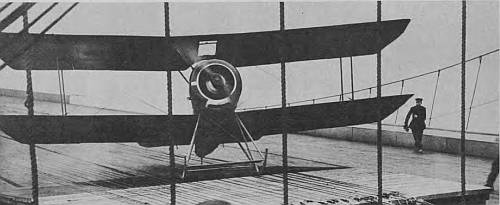
The generalisation of terms as used by Jose does not, however, give a clear picture. His reference to a ’seaplane’ appears ambiguous, because landplanes only were used in these particular launching trials, and he was probably referring to Australia’s 1½ Strutter, a landplane being operated at sea. This aircraft is shown in a much published photograph (IWM Q.18729 and AWM EN.343 and EN.544) taking off from a ramp over the 12 inch guns on the amidships starboard ‘Q’ turret while Australia was at Rosyth. It is believed that the pilot on this occasion, 8 March 1918, was Flight Sub- Lieutenant Simonson - he is shown flying solo from the anchored Australia and the turret is turned into a strong wind, as is evident from the flags flying on HMNZS New Zealand in the background. The official caption for the Imperial War Museum photograph stated merely ‘HMAS Australia. Sopwith 1½ Strutter flying from platform built upon a turret,’ while the Australian War memorial caption - ‘An aeroplane starting on a trial flight from HMAS Australia in harbour, Rosyth, Scotland, in December 1918′ - appears to be wrongly dated because Australia at that stage was carrying the Ship’s Strutter, F.7562, which was produced later than the aircraft shown in the photograph.

Additional evidence of the many misleading statements associated with the history of early Australian naval aviation exists in Rear-Admiral Sir Sidney Eardley- Wilmot’s Our Navy for a Thousand Years, which featured the aforementioned photograph with a caption stating that the aircraft is being launched from New Zealand instead of Australia. This error is perpetuated in the National Maritime Museum publication, Flying in the Royal Navy, 1914-64, by G.P.B. Naish, which has the same photograph and incorrect caption; as also does the otherwise authoritative History of Aircraft Carriers published in 1969 by Normal Polmar.

Other complications exist in the Strutter’s fuselage number which clearly reads 5644 and yet official records show that the numbers 5642 to 5648 were allocated to seven FE2a and 2b aircraft. The use of suspect or corrupt serial numbers was not uncommon and in Profile Publication, Number 13, The Sopwith Pup, J.M. Bruce reproduced a photograph of Pup 9497 carrying the incorrect number N.9497; an enlarged version of this photograph also appeared in the same author’s British Aeroplanes 1914-18. In all probability, therefore, the correct number for Australia’s 1½ Strutter was N.5644, a two-seat Type 9400 built by Mann, Eggerton and Company, which also operated later from New Zealand. (Of added interest is the fact that another 1½ Strutter, its wheels replaced by a skid undercarriage, took off on 20 March 1918 from wooden troughs on the deck of the carrier HMS Vindex. This aircraft was the single-seat Type 9700 Strutter, A.6911, piloted by Lieutenant W.G. Moore )

Notwithstanding the claim by Jose that a two-seater first took off from Australia on 8 March, H.A. Jones, also referring to Australia, stated that ‘on April 4 1918 Captain F.J. Fox, RAF, in a Sopwith, carrying an observer and full wireless equipment, made the first flight in a two-seater from a British warship.’ This latter claim has been reiterated by Bruce in British Aeroplanes 1914-18, Thetford in British Naval Aircraft Since 1912, and in Harleyford’s Marine Aircraft of the 1914-18 War. Presumably Jose was referring to the first two-seater launching with a pilot only, and Jones, and others, to the first fullyloaded two-seater takeoff.

As a result of these achievements, ‘. . . it was decided to fit the forward turrets of all battle cruisers with extended platforms for two-seater aeroplanes, and the after turrets were to carry the single-seat fighters,’ stated H.A. Jones. Again this was not the case with the Indefatigable Class battle cruiser for their aircraft were carried on the amidships turrets; actually HMS Indefatigable was lost in the Battle of Jutland, and Australia and New Zealand were the only other warships of this type. Australia usually carried the Strutter to port on ‘P’ turret, and the Camel to starboard on ‘Q’ turret. In addition, Jane’s Fighting Ships, 1921, shows an aircraft being carried on the amidships turret of yet another battle cruiser, HMS Lion; as does Oscar Parkes’ British Battleships (1966) which featured the battle cruiser HMS Inflexible with an aircraft on a flight platform over the amidships turret. Parkes’ classic publication had a photograph of Australia carrying two aircraft, mistakenly captioned ‘The Australia in 1917 with aircraft ready to fly off.’ This, of course, should read 1918. The facts in the foregoing paragraphs are described in detail because of the numerous conflicting accounts, published over a period of 50 years, of Australia’s participation in this early episode of naval aviation history.

As 1918 progressed Strutter A.6968 and Camel N.6790 were carried on Australia, and later replaced by Strutter F.7562 and Camel N.6828. Pilots mentioned in Australia’s Ship’s Log include Captain Fox, who apparently spent most of 1918 on Australia, Flight Sub- Lieutenant L’Alouette, Lieutenant Paxman, and Captain Pritchard, who left on 3 August to join HMS Barham. Post-war photographs taken in December 1918 show Strutter F.7562 and a Camel aboard Australia at Rosyth. On 9 December 1918 the Australian Naval Board decided to purchase the aircraft attached to the Australian warships - the Strutter and Camel on Australia, and each of the Camels on HMA Ships Sydney and Melbourne. The Rear-Admiral Commanding then suggested that, unless it was planned to establish a local naval air service, it would be bad policy to retain the aircraft because of lack of facilities in Australia. Acting on this advice the Naval Board rescinded its decision, and the three warships landed their aircraft before returning to Australia in 1919.

Sopwith Ship’s Camel

The Sopwith 2F.1 Camel was a shipboard development of the Sopwith F.1 Camel which operated with the Australian Flying Corps. Both the F.1 and 2F.1 single-seat scouts served with the Royal Naval Air Service; in fact five naval F.1s from Dunkirk were the first Camels to go into action when, on 4 July 1917, they attacked a Gotha formation returning from a raid over England. The prototype 2F.1, or Ship’s Camel, first flew in March 1917, and by October 1918 112 of them were aboard ships of the Grand Fleet. The rear half of the 2F.1 fuselage was detachable to permit storage on ships, and the aircraft usually carried a single Vickers gun in the port position, together with a Lewis gun mounted above the centre section, instead of the twin Vickers guns of the F.1. The 2F.1 Camel mainly operated with a normal wheel undercarriage and took off from the decks of carriers, gun-platforms on cruisers and battleships, and lighters towed by destroyers. The main operation role of the 2F.1 was to intercept Zeppelins over the North Sea, and on 11 August 1918, Zeppelin L.53 was shot down by Lieutenant S.D. Culley, whose Camel, N.6812, is preserved in the Imperial War Museum. Zeppelins were also attacked in their sheds, as for example on 19 July 1918, when several 2F.1s from the aircraft carrier HMS Furious destroyed Zeppelins L.54 and L.60 at Tondern. 2F.1 Camels were used as well in experimental launchings from the British airship R.23 in 1918, although the Germans had flown an Albatros D III scout from Zeppelin L.35 a few months earlier on 25-26 January.

After the first flight of a Sopwith Pup from Sydney on 8 December 1917, Captain Dumaresq was anxious to test the cruiser’s revolving platform with a more modern aircraft. On 14 December a signal was despatched from Sydney to the Scapa Flow aerodrome at Smoogroo: ‘As Dublin’s pilot has to return shortly . . . requested that Campania may be asked to supply a pilot and Camel, or standard Pup, complete with 2 mechanics, to Sydney.’ Two days later, presumably after much worried thought, a perplexed query came back, ‘Does Camel refer to part of equipment or to a particular type of aeroplane?’ Sydney promptly and patiently spelt out the answer; ‘The machine referred to is a Sopwith Camel aeroplane. It is the latest standard fighter and has succeeded the Pup.’ Perhaps in all fairness to the Navy shore staff they could not be blamed for querying why an Australian cruiser, anchored in the middle of Scapa Flow, was asking for a camel to be delivered to the ship - they probably thought it was some kind of delicacy the wild colonials served for breakfast. Undeterred, Dumaresq persisted in his endeavours and, after an invitation to the captain of the carrier Campania to be his dinner guest, eventually got his Camel.

It would appear that Sydney received her Camel about the same time that Australia took aboard her 2F.1 in February 1918. Both ships began to use their aircraft as often as possible, and Sydney found her revolving platform to be a great success. In Australia’s case the Camel was launched from the aircraft ramp over the amidships 15-inch guns, first on the starboard ‘Q’ turret, and later from the port ‘P’ turret. Generally a Camel occupied one of these positions, and a 1½ Strutter was carried on the other ramp. However, on at least one occasion, Australia operated two Camel aircraft together, for the Ship’s Log of 22 October 1918 recorded that one Camel was flown off ‘P’ turret at 9.10 a.m., and another was launched from ‘Q’ turret at 9.20 a.m. Meanwhile, in March 1918 Melbourne had been fitted with a revolving platform, similar to that installed in Sydney.

Her pilot, Flight Lieutenant L.B. Gibson, Royal Air Force, arrived on 14 April and made the first flight on 10 May.

On 1 June the Camels from Sydney and Melbourne were launched on their first operational flights. A large naval force had assembled to carry out a raid into Heligoland Bight and included the Second Light Cruiser Squadron (with the two Australian cruisers), followed by the two large cruisers HM Ships Courageous and Glorious, fitted out to carry aircraft, and the First Battle Cruiser Squadron led by Admiral Beatty’s HMS Lion. In the late Saturday afternoon, when the force was well under way, two enemy seaplanes suddenly appeared in a break in the cloud cover heading towards the battle cruisers. This was the emergency for which Dumaresq had been waiting. Sydney’s pilot, Flight Lieutenant A.G. Sharwood, Royal Air Force, was on duty close to his aircraft, a bugle call summoned the despatching crew and the Camel was on its way within two minutes of receiving the alarm. On Melbourne the procedure was similar, with Gibson following Sharwood in a rapid climb to intercept the raiders.

Meanwhile, the enemy aircraft had reached the battle cruisers, dropped five bombs, and were back over the light cruisers within five minutes. Unfortunately, in climbing up through the clouds, Gibson lost sight of his opponents and returned to Melbourne. Observing Gibson’s return, Courageous, which had not yet launched an aircraft, refrained from doing so. But Sharwood’s quick getaway from Sydney was paying dividends. He had his quarry in sight, and slowly but surely began to overtake him in a 60-mile chase. Sharwood eventually got within firing distance and gave the seaplane several bursts from his machine-gun. The German aircraft dropped away into a spinning nosedive through the mist, and Sharwood was about to follow it down when he sighted a second enemy aircraft behind him. He turned, climbed, and gave combat. Soon afterwards one of his guns ran out of ammunition and then the other jammed; Sharwood broke off the engagement and headed back in the direction of Sydney. He had just about given up hope of finding his parent ship when he sighted two British light cruisers and several destroyers. To add insult to injury one of the ships then fired at him. Sharwood flew down, identified himself, and ‘took the water’ ahead of the destroyer HMS Sharpshooter. Whether or not this ship was the offending ’sharpshooter’ is not known. Sharwood ditched successfully - this was the only way that landplanes operating from ships other than carriers had of returning to their floating bases - and his Camel remained buoyant with its tail in the air. Sharwood clung to the tail for 20 minutes before he was picked up, and the Camel was later salvaged by the light cruiser HMS Canterbury.

It was an eventful occasion in which, as one of his colleagues lightheartedly observed, Sharwood had been able to combine his Saturday evening bath with a successful operation. But a more serious appraisal of the incident has been recorded:

‘The achievement of the Sydney’s aeroplane went practically unrecognised’ (wrote the Australian Official Historian), ‘the officer in command of the light cruiser squadrons having apparently taken it for granted that Sharwood had shared Gibson’s bad luck. Further, Sharwood did not even get credit for having shot down an enemy machine, since he could not state that he had seen it fall into the water. But the operation - whether the German aeroplane was destroyed or not - was entirely successful. The German scouts were after bigger news than the presence of light cruisers or even battle cruisers; they wanted to know whether the Grand Fleet was out - and in a few minutes more they would have known. Before, however, they had seen more than the Lion and her comrades . . .the ‘planes from the Australian ships were rising to intercept them, and they were forced to return in a hurry. On the other hand, had they neglected these two ‘planes and gone on to find out what they were looking for, Sharwood and Gibson would have caught and probably destroyed them, or at any rate detained them so long that the Courageous could have sent hers to complete the work.’

One interesting official photograph shows the air element personnel required to fly and maintain a Camel aboard a light cruiser. Taken on Sydney at Rosyth on 2 July 1918 the caption lists Royal Air Force pilot Lieutenant Brewin and naval air-mechanics C. Graffy, R.H. Radcliffe and E. Birch. Individual Camels which were carried at separate times by the Australian warships included N.6822 and N.6638 on Sydney, N.6970 and N.6828 on Australia, and N.6794, N.7104 and N.6603 on Melbourne. The three ships each carried a Camel on 21- 22 November 1918, when, with the Grand Fleet, they escorted the German High Seas Fleet into captivity. Photographs taken in December show that the Australian ships were still equipped with aircraft but early in 1919 the Sopwith 2F.1 Ship’s Camels were returned to the Royal Air Force.

Possibly related posts

Join the Society today

This article was originally printed in the Naval Historical Review - March 1974 edition.
If you enjoyed this, then why not take out your own subscription. The Review is published quarterly to all members of the Society. By joining the Society you will always have the latest copy on hand and well before it comes onto the web site.