- Author
- Payne, Alan
- Subjects
- None noted
- Tags
- None noted.
- RAN Ships
- None noted.
- Publication
- December 1971 edition of the Naval Historical Review (all rights reserved)
Prelude to Invasion of Normandy
In November 1940, the Battle of Britain was over. The German Navy had suffered heavy casualties during the Norwegian campaign and was now licking its wounds. Churchill was itching to get at the enemy – he boldly reinforced Wavell’s Middle East Armies with troops and armour.
A token of Churchill’s offensive spirit lay on the slipway at the Fairfield Shipyard, Glasgow that November – this was the first of a new breed of tank landing craft, the first seagoing landing craft ever designed. The whole concept of amphibious warfare was to be revolutionized by the advent of these new landing craft, later to be known as LCTs. From this small beginning in late 1940, the number of LCTs constructed in Britain was to swell to a figure of over 1,200 by 1945.
The 150 flat bottomed LCTs had a certain functional beauty as the bright paintwork shone in the autumn sunshine. I guessed the new LCTs would be shipped on to the Middle East, they were built in four sections for this purpose. A few weeks later the destroyers Napier and Nestor ran their trials and were handed over to the Royal Australian Navy; the pressure of work in the shipyard increased, and the picture of the LCT sparkling on the slipway soon faded away.
In July 1940, Churchill began to prod the Ministry of Supply – his memorandum of 7th July reads `What is being done about designing and planning vessels to transport tanks across the sea for a British attack on enemy countries?’
The design was given to a young Naval Constructor, Mr. Roland Baker. Fortunately for the Navy, Baker happened to be the ideal man for the job, a constructor with an inventive mind, exuberant spirit and no respecter of rank.
Within three days he had produced a sketch design for Landing Craft Tank, Mark 1. This was the craft I had seen at Glasgow. It could carry three forty ton tanks at 10 knots, discharging them through its bows over a ramp. Later Baker was to be responsible for other designs, including the famous LST – Landing Ship Tank, and in 1942, he was appointed Superintendent of Landing Craft and special Advisor to the Chief of Combined Operations, Lord Mountbatten.
In March 1941, I joined the Naval Construction Department of the Admiralty. In September 1943, I joined the section dealing with Major Landing Craft; this formed part of the group dealing with all Combined Operation Ships and Craft.
On the 8th September Italy surrendered unconditionally and next day, the war’s first large-scale opposed landing in Europe began at Salerno. At first, the landing went very badly, and there was great danger of the enemy breaking through to the beaches. Devastating naval gunfire saved the day. The lessons learned at Salerno were to be applied with even more devastating effect in Normandy only nine months later, it was ‘an important and pregnant victory’ as Churchill described it.
Support Craft
There is a cryptic entry in my diary for December 2nd 1943 – `All British Major Landing Craft dumped on me – LCT1, 2, 3 and 4. LCF, LCT(R), and LCG(L)’. The support craft were all converted LCTs and from the design point of view, the most interesting of the landing craft family; except for the first LCG(L)s they were well designed and were extremely successful.
A lesson learnt at Crete was the need for special anti-aircraft landing craft. Two LCT(2)s were accordingly converted to prototype LCFs and were respectively armed with heavy and light AA guns. LCF1 was a most formidable craft armed with two 4″ twin mountings, while LCF2 adopted a light AA armament of eight 2 pounder guns and four 20mm Oerlikons. The Landing Craft Flak were the first of the support craft, and the only Royal Navy Warship Class to have a German name – Flak being the German for anti-aircraft.
By June 1942, six of the LCFs were in service, but the design of LCF1 was not repeated, all LCFs except LCF1 carried light anti-aircraft guns. A total of 46 LCFs were converted.
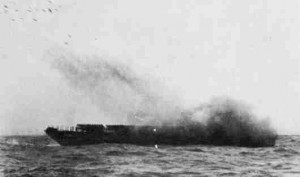
The most deadly of the Support Craft was the fantastic Rocket Craft, known as LCT(R). Colonel Langley of Combined Operations Headquarters was responsible for this most spectacular development of naval firepower, he had the inspiration to use 65lb explosive rockets fired from banks of projectors mounted in LCTs. A single craft could carry over a thousand of them. The drenching effect of a pattern of those rockets in a small area was far greater than could be achieved by any other means and often demoralised enemy troops at crucial moments of the assault. LCT(R)s were first used with great success during the Sicily landings. As the Highland Division got to within a half mile of touchdown, there was a roar from astern of them, and a sheet of flame leaped high in the air. There was a multitude of deafening crumps ahead of them as 2,500 rockets exploded on the defences; the troops landed with less than a dozen casualties, thanks to the deadly fire power of the LCT(R)s.
The third type of Support Craft and the most versatile of the lot were the gunboats – the LCG(L) All were armed with two 4.7 inch naval guns.
After Salerno it was decided to have more gunboats, and I got out a new design based on a LCT(4) hull; this was a distinct improvement on the previous design, and had superimposed guns. My chief memory of the trials of the first of the ten LCG(L)(4)s was the way the cork dusting in the accommodation flew all over the place when the 4.7 inch guns were fired.
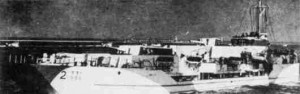
Immediately after being dumped with all British Major Landing Craft, the entire weekend was spent on the design of an extraordinary improvised support craft using the American LCT5. For this craft, I had a profound contempt, as it was simply a glorified pontoon with a ramp at one end and the machinery and accommodation at the other. Actually LCT5s did good service in the Pacific. This support craft, which was a bit of a monster, was known as LCT(A) – the A being for Armoured – which gave no clue to their function whatsoever.
The role of the LCT(A), which was fitted with 50 tons of side armour was to mount two outmoded Centaur tanks, the after one being mounted on a platform. In order to gain more space for ammunition, the engines of the tanks were to be removed.