
- Author
- Gallagher, L. S. QMG
- Subjects
- None noted
- Tags
-
- RAN Ships
- HMAS Huon I, HMAS Warrego I, HMAS Swan I, HMAS Tasmania, HMAS Penguin (Shore Base - Balmoral), HMAS Australia I, HMAS Sydney I, HMAS Parramatta I, HMAS Melbourne I
- Publication
- December 1971 edition of the Naval Historical Review (all rights reserved)
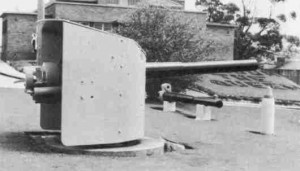
Relics of SMS Emden bask in the sunshine on the lawn of HMAS Penguin at Balmoral, Sydney. The principal relic is one of the German cruiser’s ten 4 1 inch guns complete with armoured half turret. Nearby lies a spare barrel and a 6 inch shell from her victor, HMAS Sydney.
The Caretaker at Penguin who maintains the relics in almost fighting condition pats the shining black barrel of the gun and says `They never had a chance. Emden’s 4.1’s were no match for the eight 6 inch guns of the Australian.’
HMAS Sydney, a Chatham Class 6 inch Light Cruiser of 5,400 tons with four stacks, was built by Harland and Wolf of Glasgow at a cost of 350,000 Pounds sterling, and arrived in Sydney in October 1913 in company with her sister ship Melbourne and battle cruiser Australia.
At the outbreak of World War I, Australia’s duty was to the `Mother Country’ and Sydney, in company with the British cruiser Minotaur, Melbourne and the Japanese cruiser Ibuki had the job of escorting the first convoy of troops from Australia. Whilst the convoy was steaming through the Indian Ocean, the German cruiser Emden landed a raiding party on Direction Island (Cocos Group) but before radio and cable installations could be destroyed, an SOS had been sent out.
Sydney, under the command of Captain J. C.T. Glossop, RN, responded to the signal, and was detached from the convoy to investigate. In the engagement that followed, Emden was set ablaze by Sydney’s gunfire and forced aground on North Keeling Island, thus bringing to an end a ship which had in six short weeks in the Indian Ocean captured or sunk 22 allied ships.
Sydney carried on duties with Melbourne in the West Indies and North America during the following year and in 1917, under the command of Captain J S Dumaresq, engaged a German Zeppelin (L.43), in a running fight. During the same year, in company with Australia, aircraft were successfully launched from specially erected revolving platforms designed by Captain Dumaresq, becoming the first RAN ship to do so.
Melbourne and Sydney continued with North Sea operations during 1918, and both were present with Australia at the surrender of the German Fleet at Scapa Flow. The three ships returned to Sydney in 1919, and Sydney with HMA Ships Tasmania, Swan, Warrego, Huon and Parramatta were paid off in 1928 and broken up at Cockatoo Dock in the following year.