The RAN in Antarctic Waters

Author
Vickridge, Lieutenant G.L.W., RANR
Categories
Naval Historical Review, RAN operations
Tags
, , , , , , , , , ,
Source

PRIOR TO 1911, AUSTRALIAN INVOLVEMENT in Antarctic exploration was limited to providing a jumping-off point for many of the expeditions. The first truly Australian venture was led by Douglas Mawson who first sailed south in that year. Although several semi-private Australian expeditions were mounted over the years, the government did not show any major financial interest until they purchased the auxiliary schooner Wyatt Earp in 1939.

Built in Norway in 1919 as the Fanefjord, she spent many years fishing and sealing in North Atlantic and Arctic waters before being bought by Lincoln Ellsworth in 1933. Renaming her for the famous sheriff of Tombstone, Arizona, the American explorer voyaged to the Antarctic during 1933, 1934, 1935 and 1938 before selling her to the Australian Government for 4,400 pounds.

Lying in Adelaide at the outbreak of war, the veteran polar ship was commissioned in the RAN as HMAS Wongala. Employed as a patrol vessel for the duration of hostilities, Wongala was principally engaged as the examination vessel for Whyalla, but her duties also included cable-laying at Darwin. About August 1945, the 403 ton schooner reverted to her former name and became a Sea Scouts’ training ship until 1947.

In July 1947, the Commonwealth Government established the Australian National Antarctic Research Expeditions - ANARE. Earlier in the same year, a planning committee was formed to advise the Government on Antarctic policy. The Navy’s representative, to advise on hydrographical work and victualling, was the Director of Plans at Navy Office, Melbourne.

Group Captain S.A.C. Campbell, RAAF, was appointed by the Committee as Executive Officer to organise and lead a three pronged Australian expedition to the Antarctic. Stuart Campbell was eminently qualified for the task; in the 1929-30 Antarctic expedition he had been a pilot of Sir Douglas Mawson’s Moth aircraft and returned again the following year. He served in HMAS Albatross, carrying out aerial surveying along the Great Barrier Reef and as a civilian, had undertaken aerial survey jobs in Western Australia and Victoria.
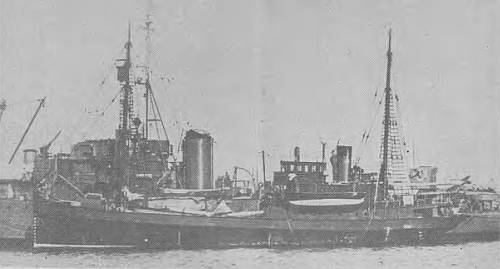
HMAS Wyatt Earp, after being chosen as the expedition vessel, was refitted in Adelaide to enable her to carry out surveying of the King George V Land coastline for the purpose of establishing a permanent continental station in the Antarctic. If possible, the expedition’s geophysicist was to reoccupy the magnetic station at Sir Douglas Mawson’s old base at Commonwealth Bay. The expedition also provided for the establishment of meteorological and geophysical bases at Heard Island and Macquarie Island.

Manned by an RAN crew under the command of Commander Karl E. Oom, RAN,1 Wyatt Earp sailed from Melbourne in late 1947. When south of Macquarie Island the ship encountered heavy seas and developed a leak forcing her to return for repairs. Finally, on 8th February 1948, Wyatt Earp sailed for the Antarctic continent with Group Captain Campbell going in her.

Owing to the extremely heavy pack ice which prevailed during the summer of 1947-48, the twenty nine year old vessel was prevented from reaching the King George V Land coastline despite two separate attempts. Thus, neither the survey was conducted nor the geophysicist landed at Commonwealth Bay. Instead, she headed east to survey the Balleny Islands, which lie close to the eastern limit of the Australian Antarctic Territory and are among the most inhospitable islands in the world.

The first recorded landing on the Ballenys was of several minutes’ duration in 1839; the second was also a brief landing, by Group Captain Campbell, Dr. P. Law and Able Seaman Wallace on 29th February 1948. The weather was too rough for a landing using Wyatt Earp’s motor cutter; even so, the heavy pounding surf forced the immediate retreat of the more sturdy whaler.

The small, slow and under-powered Wyatt Earp proved unsuitable for the requirements of ANARE and the 1948 voyage was her last to Antarctic waters. She was honourably retired and, under private ownership, engaged in the Australian coastal trade as Wongala, and later, Natone. In January 1959 the veteran polar ship was lost off the Queensland coast.

The second RAN vessel to be actively engaged in Antarctic exploration work was HMAS LST 3501. Built by Canadian Vickers in 1943, the Landing Ship Tank was not commissioned into the RAN until after the war. The least conventional of all polar ships, the 2,300 ton vessel served in the founding of the Heard and Macquarie Island stations in 1948 and thereafter in relief operations.

Refitted and adapted at Garden Island Dockyard for Antarctic conditions, the Navy landing ship had all the accoutrements of war removed and was painted yellow from stem to stern; the bridge housing was fully enclosed to provide all-weather protection. Preparations by the RAN Victualling Stores included furnishing the two island parties each with food stocks for fifteen months.

Prior to the departure of LST 3501 from Melbourne on 17th November 1947 the Minister for the Navy, Mr. Riordan, inspected the ship and a naval guard of honour, and was introduced to members of the Heard Island expeditions, the first group to be taken south. In a farewell address on behalf of the Commonwealth Government, the Minister said that it was the first time that any country had planned three separate expeditions to Antarctic regions.

Commanding Officer of the landing ship was Lieutenant Commander George M. Dixon, RANVR, who had seen service during landing operations in the Mediterranean and at Tristan da Cunha, and was one of the most experienced officers in this type of operation in the RAN.

After leaving Fremantle the LST encountered a heavy gale during which deck cargo broke loose, mess-decks flooded and only fifty miles progress was made in twenty four hours. Further difficulties arose when the main oil feed pump stopped and for over an hour, the flat-bottomed vessel was left wallowing lifeless and beam on to the heavy swell.

LST 3501 arrived at Heard Island on 11th December and Lieutenant Commander Dixon, not unmindful of the hazardous nature of the landing to be undertaken, informed all aboard that; ‘While it is calm, landing operations will be carried out unceasingly so long as there is sufficient light, by either sun or moon.’ It was a race against the elements.

In Melbourne it had seemed unlikely that the LST would be able to beach but after a week of several near disastrous attempts using the two LCVPs (Landing Craft, Vehicles and Personnel), a work-boat and a dinghy, Lieutenant Commander Dixon beached 3501. While manoeuvring her off the beach after the first of three landings, the LST went aground for an anxious three hours.

On 21st December a storm, so severe that the pen ran off a barograph set up ashore, hit the ship and there were further anxious hours while the flat-bottomed vessel clawed its way off a lee shore in a 120 knot gale.

LST 3501 finally sailed on 28th December for Kerguelen Island and there heard the news of Wyatt Earp turning back. Dixon was instructed to return to Heard Island and take off Group Captain Campbell who had sailed with the expedition; it was apparent that there was not enough of the season left for Wyatt Earp to call at Heard Island in March or April as originally planned.

On return to Melbourne it was necessary for the LST to be docked for inspection and overhaul before sailing with the Macquarie Island party on 28th February 1948. Wyatt Earp met up with 3501 while the latter was at Macquarie Island landing the expedition under less hazardous conditions than at Heard Island. Dixon returned to Melbourne with seals and penguins for the Melbourne Zoo.

Because of the lack of a suitable vessel to replace Wyatt Earp, future expeditions in which the RAN was involved were confined to the annual relief of the two Island parties. On 2nd November 1948, 3501 was renamed and it was as HMAS Labuan that the landing ship sailed south in 1949. On this and all subsequent occasions, Army DUKWs were used in the landing operations with great success. After relieving the first Heard Island party, a survey of the remaining two miles of uncharted coastline was completed.

In July 1950, HMAS Australia made a mid-winter dash south to Heard Island to evacuate the expedition’s medical officer who was critically ill, and land two reliefs.

The major problems with early ANARE expeditions were the finding of a suitable ship, and landing supplies. Labuan, which had done excellent work in carrying the pioneer parties, continued to carry out the annual relief of the Heard Island and Macquarie Island stations under the direction of the RAN. It was obvious, however, that a ship of her kind could not continue to indefinitely batter her way down each year on the 3,500 mile voyage and it was not altogether surprising that in 1951 she finally became unseaworthy after a particularly rough passage to Heard Island.

The RAN had no other vessel suitable for Antarctic operations and Labuan’s return to Fremantle on 1st March 1951 marked the last operation by an RAN vessel in Antarctic operations.

RAN Antarctic Operations

1948 Heard Island Expedition - HMALST 3501 (LCDR G.M. Dixon, RANVR)

  • Sailed: Melbourne 17/11/47
  • Called: Fremantle 25/11/47 - 28/11/47
  • Arrived: Heard Island 11/12/47
  • Sailed: Heard Island 4/1/48 (First sailed from Heard Island for Kerguelen Island 29/12/47, later returned to take off Group Captain S.A.C. Campbell, RAAF)

1948 Macquarie Island Expedition - HMALST 3501 (LCDR G.M. Dixon, RANVR)

  • Sailed: Melbourne 28/2/48
  • Sailed: Hobart 3/3/48
  • Arrived: Macquarie Island 7/3/48
  • Sailed: Macquarie Island 23/3/48
  • Arrived: Melbourne 2/4/48 after calling at Hobart

1948 Wyatt Earp Expedition - HMAS Wyatt Earp (CMDR K.E. Oom, OBE, RAN)

  • Sailed: Melbourne 8/2/48
  • Arrived: Melbourne 1/4/48 after calling at Macquarie Island

1949 Heard Island Expedition - HMAS Labuan (LCDR G.M. Dixon, RANVR)

  • Sailed: Melbourne 21/1/49
  • Arrived: Heard Island 3/2/49
  • Sailed: Heard Island 11/2/49
  • Arrived: Melbourne 26/2/49 after calling at Kerguelen Island

1949 Macquarie Island Expedition - HMAS Labuan (LCDR G.M. Dixon, RANVR)

  • Sailed: Melbourne 22/3/49
  • Arrived: Macquarie Island 27/3/49
  • Sailed: Macquarie Island 8/4/49
  • Arrived: Melbourne 14/4/49

1950 Heard Island Expedition - HMAS Labuan (LCDR D. Shaw, RAN)

  • Sailed: Melbourne 22/1/50
  • Arrived: Heard Island 11/2/50
  • Sailed: Heard Island 25/2/50
  • Arrived: Albany 11/3/50 after calling at Kerguelen Island

In July, 1950 HMAS Australia mad a mid-winter dash to Heard Island to take off the Expedition’s medical officer and land two reliefs.

1950 Macquarie Island Expedition - HMAS Labuan (LCDR D. Shaw, RAN)

  • Sailed: Melbourne 3/4/50
  • Arrived: Macquarie Island 10/4/50
  • Sailed: Macquarie Island 24/4/50
  • Arrived: Melbourne 29/4/50

1951 Heard Island Expedition - HMAS Labuan (LCDR I.H. Cartwright, RAN)

  • Sailed: Melbourne 16/1/51
  • Arrived: Heard Island 5/2/51
  • Sailed: Heard Island 17/2/51
  • Arrived: Fremantle 1/3/51 after calling at Kerguelen Island

Footnote:
1 - Commander Karl Erik Oom, OBE, RAN

Born 27th May 1904 at Chatswood, NSW, and entered the RANC in January 1918. Promoted to Midshipman in 1922, Sub-Lieutenant in 1925, Lieutenant in 1926, Lieutenant Commander in 1935 and Commander in 1943. He specialised in hydrographical work and was engaged in surveying from 1926.

Oom signed on as an Able Seaman in Discovery II for Sir Douglas Mawson’s 1930-31 Antarctic expedition where he met Stuart Campbell for the first time. For his work with the expedition he was awarded the Polar Medal. His next expedition was in HMS Challenger which Oom joined in 1932 for a two year survey off the Canadian northern coast after which he returned to serve in HMAS Moresby.

The hydrographer again returned to Canada, surveying this time in HMS Franklin, in which ship he was serving when World War II broke out. Lieutenant Commander Oom was appointed to command HMS Gleaner during 1941-42 and then returned to Australia to command HMA Ships Whyalla (1942-43) and Shepparton (1943). In 1943 he became Officer-in-Charge of the Hydrographic Branch and Commander Task Group 70.5 Seventh Fleet, a position he held until the cessation of hostilities.

In February 1945 he was awarded the OBE, and his work was also recognised by the award of the United States Legion of Merit. The Royal Geographical Society presented him with the Gill Memorial Prize and the United States again recognised his outstanding contribution to surveying by awarding him the Bronze Star.

Possibly related posts

Join the Society today

This article was originally printed in the Naval Historical Review - March 1971 edition.
If you enjoyed this, then why not take out your own subscription. The Review is published quarterly to all members of the Society. By joining the Society you will always have the latest copy on hand and well before it comes onto the web site.