The Touch and Go War

Author
Goldsworthy, Lieutenant Commander L V GC DSC GM RANVR
Categories
History - general, Naval Historical Review
Tags
No tags for this post.
Source

About the Author: Lieutenant Commander Leon Verdi Goldsworthy was born in Broken Hill, NSW, in 1909. Mobilised as a Sub-Lieutenant on Probation in 1941, he proceeded to England, there to begin a long career of mine disposal. He was awarded the George Medal in April 1944 and the George Cross in September 1944. In January 1945 he received the DSC for stripping the first German ‘K’ mine. Lieutenant Commander Goldsworthy now lives in Perth.

MINES ARE INTERNATIONAL and of many kinds. In this article they are German moored and influence mines used by the Germans in the 1939-45 War. By definition a mine is any quantity of explosive which may be detonated by a time device, a chemico/mechanical or chemico/electrical device, a chemical etch, electrolite, magnetic forces, acoustics or combinations of these two and pressure. These were the weapons against which a small group of specialists were to pit their brains, training, experience and lives from the first days of the war.

The war was only weeks old when it was realised that ships were being sunk by other than conventional moored mines. The Orepesa minesweepers detailed to sweep the mines had as little immunity as other vessels.

The brilliant recovery of two unexploded magnetic mines at Bhaeburyness in November 1939 provided grim proof to the Enemy Mining Section of HMS Vernon of the war it was to fight. From that time forward a macabre competition developed between German inventors and individual members of EMS. It was a fierce and unyielding competition.

So confident did the Germans become that two special mines were laid near the quarries used by the Enemy Mining Section for the final breakdown of ‘captured objects.’

As the war progressed, so did the frightfulness of the weapons employed. ‘Self destroy’ mines and acoustic mines sent British shipping losses upward. While EMS was attempting to grapple with the problem of these new weapons, Hitler launched his blitzkrieg on the cities of England.

The first of the blitz weapons was the parachute mine. The section, which up to then had worked at sea or close to the sea, soon found itself working in the cities selected as the Germans’ target.

Night after frightful night his bombers dropped incendiary and high explosive bombs and parachute mines on London and its docks, on other ports and cities.

In the long term the German switch from the sea to the land was a mistake. The armourers were diverted from the magnetic and acoustic mines, which were still mystery weapons, to the conventional bombs and mines. As the tempo of the raids increased, mines were dropped on land with the magnetic and acoustic units still fitted. The recovery of some of these latter mines provided bodies for examination.

The task imposed on EMS soon outstripped its capacity and very soon a larger unit, the Rendering Mines Safe Section, was hastily formed. It was based on Admiralty in London and after only minimal training was set to work. Their orders were simple and to the point: ‘get rid of the damned things.

This the section proceeded to do - in the streets and in the warehouses, in theatres, in the quiet of the countryside, in the stinking bowels of a gasometer, welded to the electrified rails of a suburban railway, mushroomed into the concrete railway over a tube station, in pubs and private gardens, and even within range of No. 10 Downing Street. The famous ‘Ronnie Smith’ mine flaunted its evilness behind the altar of St. Paul’s. Many lay buried and inaccessible.

The section comprised Wadsley, Syme, Mould, Gidden, Armitage, Newgas, Fenwick, Smith, Taylor, Kessack, Reid, Cliff, Upton, Gosse, Goldsworthy and others.
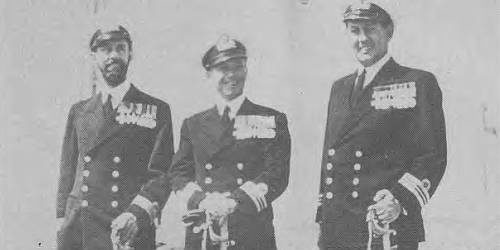
They were accommodated in a single room in Banks Block at Admiralty and this became the cradle, haven, school and workshop of a band of warriors who cringed and worried all night during the raids but sallied forth at first light to delouse or destroy - to be lucky or be destroyed.

The products of their successes accumulated in cupboards, on tables and temporary benches and sometimes overflowed onto the floor. Bomb fuses, detonators, boosters, clocks, tail caps and parachutes presented one chaotic jumble to the eyes of other Admiralty inmates.

Vernon claimed Mould and Syme who had already become a naval tradition. Their names became associated with Overy, Lewis and Glenny in the ‘if at all possible render safe‘ rules of the Enemy Mining Section.

This redoubtable team assisted in the recovery of every form of nastiness the enemy dropped, fired or floated onto the British Isles. Syme dived (illegally, in the most unsuitable gear) and Mould searched the mud and quicksands of the tidal flats for mines of every type.

Syme on one occasion dived for a mine near Spit Sand Fort in the approaches to Portsmouth. His gallery, and almost his cortege, was a group of US and Canadian ‘learner’ officers. He sighted his quarry at the end of a wearisome search but was forced to surface by the increasing ebb without having the opportunity for close examination. The mine exploded as his handlers were swinging him into the landing steps. ‘Jeez, is that what it’s like?‘ asked a mud splattered North American.

The Admiralty team was now in new quarters in Charing Cross Road and renamed the Land Incident Section. It had acquired power, prestige and much paraphernalia. Whole trains were available to the section at an hour’s notice to whisk personnel and equipment anywhere in the United Kingdom. Humbers, festooned with blue priority lights, magnetically operated bells and fitted with War Office number plates had replaced the left hand drive Fords. Tools were now really magnetic. A secret telephone was installed with a priority only second to Cabinet.

L15 was still mainly a disposal force. Outposts were established in Edinburgh, Glasgow, Liverpool, Leeds and Bristol and markedly reduced the time taken to arrive on site. New mines were reported to Vernon whose privilege it was to attempt recovery.

The Barrow in Furness baby blitz saw two SMOs operating in the same area. They were working on two separate objects, unaware of each other’s presence until they made their safety runs and crashed into each other, well within lethal range of each other’s exploding mine. The presence of a string of railway trucks saved them, to live another day.

Mould, in the same area and working on a spotter’s report of one splash, recovered a parachute mine in the basin. ‘She’ll be right,‘ he called out to his section, whereupon all were knocked flat when the mine exploded prematurely. The explosion also sunk a Polish submarine, one of two survivors of a hazardous escape from the Baltic.

Jack Cliff, with an American observer, found and rendered safe a mine in the Belfast Town Reservoir. To reach the mine, he drained the reservoir and was thereafter dubbed ‘Contractor Jack.

Another recovery made by Cliff was on the noisy Great Western Railway Bridge just outside Plymouth Naval Depot. The author was his gadgetman on this job but was shortly afterwards posted to ‘Overy’s Boys.’

The original team was becoming scattered. Red Kessack was dead, Gosse was sweating it out in Madras and Rawson, the Boy Meets Girl cartoonist, was in Australia. Wally Dray and Grant were in training for the North African Invasion, Plowman was in Alexandria. Keith Upton, the man from Thursday Island, embraced a torpedo and disappeared into the Pacific. Dudley Reid, the author’s nurse on his ‘learner job‘ went to sea.

Overy’s Boys‘ were assured of variety. After a quick familiarisation run off Holing Island the author, with only a WRNS driver to watch his work, was rendering safe a dozen German moored mines which came ashore in a wild gale.

The Hague Convention stipulated that moored mines which break adrift should be safe while floating free. The Germans flaunted the code by attaching a weight below the mooring shackle which effectively remoored the mine in shallow water. This device was called the ‘lavatory seat.’

These errant mines created situations often not foreseen by the most conscientious RMSO. Occasionally the mines came ashore close to waterfront homes and the occupants were hurriedly evacuated. Very soon the RMSO was receiving requests to feed Mrs. Brown’s tomcat or Mrs. Jones’ canary.

1942-43 The Drifters
The winter of 1942-43 was particularly severe and a great number of ‘drifters‘ menaced channel shipping and were a constant menace to the little ships of magnetic and acoustic mines sweeping forces. Beach defence and first wave light AA gunners were given permission to fire on and destroy mines in the water. The laid down ‘safe distance‘ was half a mile, but gunners often fired at point blank range with disastrous effect on their emplacements and nearby buildings.

Back in the influence field, recovery began to pay off. Statistical evaluation of serial numbers, of types, of colour markings and particularly knowledge of the arsenals where the mines were manufactured and even the way in which certain German scientists were thinking, began to paint a picture.

The diabolic pattern was everchanging. Self destruction devices were followed by acoustic mines designed to destroy the sweepers; variations were endless and in some cases it was necessary to sweep a stretch of water fifteen times before it could be declared free. Britain almost, but not quite, starved in this wearying period.

In North Africa the Germans not only mined approaches and harbours, but also planted mines under jetties, hung them over breakwaters, poked them into the machinery of slipways and concealed them in repair shops. On a wet Sunday afternoon in Vernon, Mouldy and the author conceived the idea of using squads of divers to locate, immobilise and destroy such objects.

From this idea developed the Vernon Diving Suit, a compromise between the Admiralty Standard Diving Dress and the Salvus Self Contained Oxygen Recirculation Breathing Equipment. The Vernon was essentially a walking suit, good enough for quick recognition dives to 180 feet, but unsuitable for large area bottom searches.

The dream suit took time to become a reality. The war made many demands on the designers of diving dress. Special suits were required for midget submarines, torpedo riders, canoeists and frogmen. In the end, all had to be satisfied with compromises.

The idea of port clearance divers was a ‘hard sell.’ Resistance came not only from the Blimps but from those with the problem of outfitting large squads of divers. There were only two manufacturers to meet the ever-increasing demand.

Mouldy, an excellent tactician, finally sold the ‘P Party‘ idea to the highest authority. He also succeeded in squeezing the Vernon Suit into the already strained production lines.

Full approval was finally received but the author, who had worked in unison with Mouldy, was refused permission to join the new unit.

Fishing ‘drifters‘ was still top priority. Esmerelda, once the pleasure yacht of the Coleman (mustard) family was fitted with every type of sweep for the task. The 105 ton, 105 foot vessel was acquired by the Admiralty after Dunkirk and her original armament was a hand cranked Gatling Signal gun which had once belonged to the Shah of Persia. With it came 13 rounds of ammunition. As the war progressed she boasted a Bofors, an Oerlikon, two Brownings, two illicit Lewis and sundry hand guns.

Esmeralda had a distinguished career. Five years of ceaseless sweeping, the first ship into Cherbourg and the surveys for PLUTO, the underwater fuel line which provided the fuel for the invasion of Europe - fine battle honours for any ship.

Other similar vessels joined Esmeralda and under the command of Lieutenant Commander Collier RNVR became known at ‘Goldy’s Sea Horses.‘ They ploughed the fields of coastal water from Plymouth to the Wash. Asdic pinging, with a bottom sweep trailing on the seabed and a baby Orepesa or a piece of complicated metal discrimination gear they search for German mines.

When the bottom sweep snapped on objects, the divers investigated. The ancient seabed was littered with an amazing variety of garbage. Among ‘finds‘ made by the team were a siege gun of the Napoleonic era, cannons of both Drake’s and Nelson’s times, barrels, bodies and a drum.

Mysterious underwater explosions in ‘H’ Channel off Aberdeen started a panic at this time. The author was flown up in weather unfit for flying. On arrival at the airport at Aberdeen it was a mad rush to the dock.

An armed trawler immediately put to sea, but when the skipper was asked for his chart, he replied he didn’t have one but knew the spot. In mid afternoon the trawler slowed, the skipper sniffed the breeze and said ‘She’s there.

A few feet beneath the surface was the mast of a sunken ship. An underwater inspection revealed the vessel sitting on her side but there was nothing to indicate whether a torpedo, snagline mine, explosive motor boat, drifting mine or a submarine laid influence mine had caused the damage.

Beneath the wreck was an aircraft which had evidently been lying on the seabed when the ship was sunk.

While the search for clues to the ‘mysterious explosion’ continued, tragedy struck nearby. The captain of an ML located a sub-laid mine and manhandled it delicately ashore at Great Yarmouth. Commander Edwards, the local RMSO, a legendary character who had rendered safe vast numbers of enemy moored mines and conical floats, obtained permission from DTM to have a go at it. In the process of stripping the mine, it detonated, killing Edwards and his American observer.

Shortly after the tragedy a similar mine was washed ashore on the same strip of beach. Mouldy was ordered to use all scientific aids in fathoming the mine’s secrets. The author with his mobile dark room and Waldron, a civilian scientist who did the lab X-ray, joined Mouldy.

Waldron also brought a sensitive trepanner. Sensitive listening devices were used to detect a possible clockwork. At one stage it was feared a gamma ray anti-stripping device might be fitted. Both fears proved negative.

Mouldy decided to proceed with a step by step strip. Shadow pictures showed in addition to the normal bits and pieces a canister about midway on the long axis. A very thin wire could be discerned stretched from the canister to the mechanism plate and aft to the main charge.

Was it a booby trip or a self destruction device? If either, how did it work? Was removal of the whole mechanism the trigger? Could the main charge be parted from the body of the mine without risk?

Sooner or later the RMSO arrived at the moment of truth. He must touch or move something. The mine was of the magnetic type but there was no certainty that it was dead magnetically. As a start the mine was gimballed and although very sensitive, the many fingered moving parts were very sluggish.

Eventually, after weighing all the probabilities, Mouldy, step by step, unveiled the ingenuity exercised by the German armourers and the mine that claimed the life of Edwards and his observer was rendered safe.

‘D’ Day and the Build Up
With the invasion of Europe drawing nearer, Mouldy was ordered to expand the Section. To do so he scoured all diving services for likely recruits. One to join at this time was the famous Bill Bailey, who won a knife fight against an Italian limpeter on the seabed in Gibraltar.

While Mouldy was busy recruiting, the author was assigned to a beached mine in Scratchell’s Bay, just inside the Needles. The only boat available was ‘Smoky Joe‘, a coal burning harbour picket boat, and the coxswain was a WRN. To reach the locality the coxswain took a short cut from the harbour entrance to Spithead. Passing close to a ship moored fore and aft, they received a verbal blast in no uncertain language. The ship was on the point of testing a one ton depth charge when Smoky Joe entered the target area. The climax of the short voyage came soon after when the coxswain admitted she had never taken a boat outside of harbour and had no idea where Yarmouth was. The voyage was completed in a TB boat which attempted to land the RMSO in a rubber dinghy, but succeeded in dumping him in a boiling surf.

On the Thursday prior to Easter 1944, an American Liberty Ship went aground in Milford Haven, Wales. While setting out kedges to keep the vessel steady until next high water, a mine was seen nose down in the blue clay of the harbour floor. The crew was taken off and the captain was most incensed at being parted from his ship.

The only boat available belonged to a harbour maintenance contractor. It was moored fore and aft by tossing three one hundredweight concrete sinkers over the stern, but when the contractor cheerfully tossed the forward anchor over it disappeared with several fathoms of unsecured chain.

The author’s first task was to dive and retrieve the errant anchor. At 10.00 on Good Friday, work began on the mine. Hardly had the examination commenced when the RMSO received a hammer blow on the kidneys. He looked up to see the diving boat moving away. Hastily signalling to be brought up he was dragged to the surface like a rocket and struck the legs of the diving ladder three feet beneath the surface. The top light of his helmet was shattered by the impact.

A grim tug of war ensued. The RMSO struggled to ease himself down and clear of the ladder while the enthusiastic handlers hauled away with gusto. Water had filled the suit when sweet reason prevailed and the lifeline was eased.

The lifeline lacked the strength to lift a diver in a water filled suit and a dangerous situation was only overcome when the RMSO drew his knife and slashed the suit to allow the water to drain out.

Later the suit was patched and the author descended to the mine again. Removing the difficult fuse was a dangerous and sensitive task. Resurfacing, he asked his handlers for a pair of footprints. The handlers were Americans and had no idea what was required. Who outside Australia ever heard a pipe wrench referred to as footprints?

Minimum safety was achieved and the team returned to a nearby American Air Force Base. Here it was learnt the cause of the kidney wallop. The Americans were unaware of the ‘temporary cessation of all activity‘ signal and had dropped a practice bomb nearby.

The mine in its blue clay bed was eventually rendered safe and the Liberty Ship was freed to deliver her cargo of goodies to the US Forces. Subsequent examination of the mechanism revealed a speck of insulating varnish had prevented the firing contacts from closing when it had been laid several years before. The RMSO had been working on a live mine all the time.

With the approach of D Day the section entered another phase of the many-faceted mine recovery business. Esmeralda pinged her way into mid-Channel seeking small snag line mines which were taking their toll of towed folboats and stripped MTBs engaged in mysterious nocturnal operations off the French coast.

These mines were moored below the surface with their long nylon snag lines floating on the surface. When caught in a propeller or other projection, the line tightened and actuated the mine close enough to destroy a small vessel or damage a larger one.

Esmeralda entered suspected areas and located the tell tale nylon lines. When the line was vertical in the water the diver entered the water, cut the mooring cable with a pair of double action wire cutters and passed a tow line to Esmeralda. The mine was then towed to a beaching site.

The work was carried out at night or under misty conditions. In the full light of day, Calais and Dover were equidistant and the German guns were only too ready to vent their hate on a slow moving vessel towing a mine.

On occasions, beaching operations were unexpectedly complicated by playful seals who thought it some kind of game.

Permission to join the first waves of invasion ships for Overlord was withheld from the Mine Recovery Flotilla. June 6th, ‘the real thing’, came and went but soon after Esmeralda with the diving boat in tow and ‘Young Cliff’ and ‘Fisher Boy’ set out bravely for new adventures.

Adventures came quicker than anticipated. Just off Portsmouth, a destroyer closed on a collision course and demanded to know ‘where in the hell‘ two coal burning fishing vessels, one pretty-pretty motor yacht and an obviously stolen battleship’s pinnace were headed.

A facetious ‘Please sir, we are going to liberate Europe‘ from Collier did nothing to allay the destroyer’s suspicions. The author’s more factual explanation eventually set things right and the destroyer allowed ‘the most ragged arsed flotilla’ he had ever seen to proceed.

The beach-head at Normandy appeared to be total confusion, overlaid with a pall of yellow brown smoke, shot from time to time by bright orange and black. No one wanted the services of the small flotilla yet. It was therefore sent off to Juno Beach to await developments.

However, it was not a long wait. The divers were soon employed salvaging bric-a-brac, placing moorings for pontoon roads and assisting in the surveys for the location of the famous Mulberries.

Another task allotted to the flotilla was the examination of the waterline of the blockships used to provide a harbour for the landing craft. The author, in the course of this examination, discovered that one scuttling charge on the old cargo ship SS Bosworth had failed to explode. On surfacing to report the find, he received another violent hammer blow to his body. Ruttle, a compatriot from Perth, had also discovered an unexploded charge and detonated it, unaware that another diver was in the vicinity.

An urgent call to Lion Sur Mer resulted in the finding of the first bomb mine. These were mines which, in addition to the usual light sensitive booby trip, had a device intended to destroy the mine under certain circumstances. The usual practice of cutting the wires and their protective tubing was certain suicide, so the ‘top hat’ mechanism chamber and booster tube were removed intact for later stripping.

The explosive charge was destroyed in situ with a gelignite pack, taken from the body of a dead frogman commando, of whom there were plenty floating nearby.

Minelaying was accelerated by the enemy at this time. HMS Repulse was completely mined on one occasion. One exploded under the stern and others were seen to fall near her anchor buoy. Tugs were brought in to hold her still until a conference with FOBAA decided she should be backed out on a certain state of the tide.

The Vernon team were to recover the mines and anchor later, but sweepers swept the mines. The anchor and chain supposedly laid out neatly on the seabed were never found.

The End of the Road
Esmeralda’s overnight berth was in the abandoned Gooseberry, close under the port side of the Old French battleship, Corbet. Here she survived the gut wrenching, ear destroying ‘whoomps’ of the monitor Lord Roberts bombarding Caen, the nocturnal two man torpedo attacks and the occasional explosive motor boat attacks. The latter were directed against Corbet but her great armoured sides proved too good for modern weapons.

Another task undertaken at this time was the rendering safe of the ‘baby’ section of a ‘mother and baby torpedo’ located on the beach to the west of Caen Canal entrance. The lethal baby was in an area being cleared by Canadian Army Engineers. Sunken tanks, lading craft and personnel carriers, gliders and many bodies were caught in the rocks and anti-invasion props of what had been Sword Beach.

The author arrived on the job without tools but eventually disarmed the little monster with a screwdriver borrowed from a jeep. The mechanism was a perfect facsimile of a British influence mine.

Off Arromanches, another new discovery was made by Esmeralda. Searches made after splash reports had failed to turn up any mines and it was not until some time later an unusual spherical object was recovered. It was a pressure vessel from a V2 or Buzz Bomb.

Cherbourg was the next assignment. The last of the forts covering the Grand Road had just fallen. P Parties were surveying the inner and outer harbours, the boat train terminal, the extensive locks and basins and the fitting out docks.

The task proved formidable. Bridges and lock gates were crumbled masses of steel, whole ships lay on their sides, effectively blocking entrances and exits. In the machine shops, lathes, drills, rollers and benders were run together in great masses of still hot metal.

Barges loaded with mines were sunk alongside wharves. Trucks full of every type of ordnance lay crushed under the fallen roof of the Boat Train Station. Train engines were toppled into the water.

In the Nandonet Tunnels were strings of railway trucks carefully labelled with the International Red Cross sign and loaded with mines, torpedoes and every form of frightfulness.

This was the background to the finding of another of Hitler’s Victory Weapons - the fearsome Katey Mine. A weapon so simple in appearance - a metal rod tripod supporting a single ‘hertz Horn’ mounted over a concrete block containing ten kilos of explosive. A snag line pulled a lever which broke the horn’s acid vial.

The author was given the task of picking the sinister contraption’s secrets. To approach the mine it was necessary to swim through a hundred yards of giant weed. The water was intensely cold and the rumbles of distant underwater explosions did not add to comfort. Despite fears of diabolical booby traps, the mine was rendered safe.

The war moved out of Normandy and the P Parties moved with it. The Mine Recovery Flotilla was coast bound, but was fully employed in wreck location and similar tasks.

In February 1945, with the European war drawing to a close, the author and ‘Contractor Jack’ Cliff were transferred to the Pacific for liaison duties with US forces. So ended the campaign which had begun with the Enemy Mining Section in 1939.

Originally printed in the Naval Historical Review - Summer 1972 Edition

Possibly related posts

Join the Society today

This article was originally printed in the Naval Historical Review - Summer 1972 edition.
If you enjoyed this, then why not take out your own subscription. The Review is published quarterly to all members of the Society. By joining the Society you will always have the latest copy on hand and well before it comes onto the web site.